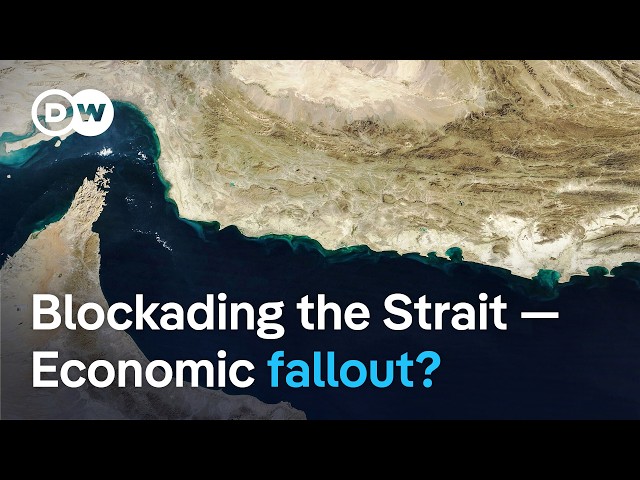
Why current oil prices do not reflect actual energy supply shortages — and might climb higher
April 14, 2026, 8:05 p.m.https://www.youtube.com/watch?v=QvLXHoyOARI
Video Transcript
We begin the day with a new naval blockade around the straight of Hormuse. After peace talks between the US and Iran ended without a breakthrough over the weekend. President Trump announced that the US would impose its own blockade on the vital shipping route. Now, since then, conflicting information has come out of the US, but the latest reports say that the blockade will be enforced in the Gulf of Oman and the Arabian Sea to the east of the straight of Hormuse. The US military said that it would prevent ships entering and leaving Iranian ports. Now, around 20% of the world's oil supplies passed through the strait before the US and Israel started the war with Iran. While Thrron has effectively closed the strait to international shipping in retaliation, it has managed to export millions of barrels of its own oil. And to look at what the latest developments around the street of Hormuse could mean for global oil prices. I'm joined now by Rory Johnston. He's an oil market researcher and founder of commodity context.com. Rory, it's good to have you with us. Let's talk about Brent crude prices. We know that they've shot back up over a hundred dollars a barrel after sinking last week on the news of this ceasefire deal between the US and Iran. What do you think? How high could prices go if no oil passes this new US blockade in the next coming weeks? Yeah, I mean oil prices even above $100 a barrel on the prompt Brent futures price are still in my mind far too low for the volume of oil we've already lost from the market, let alone the upside risk of how much additional oil we could lose should this situation, should this war escalate further. um with Brent right now for prompt futures over $100. We're looking at dated Brent uh the kind of more spot price at more like $125 $130 a barrel and physical delivered premium on those are over $20 on top of that. So over 150. So the oil market is screaming out for additional supply and as long as Hormuz remains closed that supply is not coming right now where we have roughly 13 million barrels a day or roughly 13% of global supplies locked in and shut in in the Gulf because of this lack of export capacity with Hormuz closed and now with the United States blockading it further and preventing Iranian flows which ironically have actually remained uh kind of part of the market supply mix this entire war thus far very very bizarrely you wouldn't expected that in hindsight, but that would raise that 13 million to more like 15 million barrels a day. So I under I can appreciate why the United States is blocking Iran's oil exports in this in this context, but it does make a currently terrible situation even worse. >> So So if I've done my math right, you're saying then about 7% of the the oil the world's oil that goes through the straight of Hormuz has been getting out with the conditions being the way that they have been for the last few weeks. Do we know where that oil has been going? Yeah. So, of that initial 20 million barrels a day roughly that that normally transits the straight of when it's not closed, roughly 7 million barrels has been rerooed. Most of that has come through the Saudi East West pipeline uh which which dumps out the uh about roughly five plus million barrels a day of diverted flows from the Gulf into the Red Sea. Um, and then on top of that, you also had roughly one and a half to two million barrels a day of of Iranian crude that continued to transit the straight prior to this blockade. Most of those barrels have all been ending up in Asia, which is the large you you know the predominant destination for most Middle Eastern exports, you know, before the war and that's where these are going to continue going, right? Because right now that's where the greatest scarcity is for these barrels is in Asia. If the US succeeds in blocking Iranian oil exports, who do you think is likely to feel the most economic pain here? Is it going to be Asia? I mean, China specifically, the vast majority of Iran's oil exports have been going to China historically, although given the recent US Treasury easing of sanctions on Iran's oil exports. Part again, another part of this that's bizarre in the context, they actually removed sanctions from Iran's floating storage to better facilitate oil supply in the near term. So, for instance, India had actually purchased its first barrels of Iranian crude since roughly 2018 or 2019 when the Trump administration first scuttled the JCPOA. So I would say that in general it's going to be China but also a little bit India but more broadly it's just the fact that these are 2 million barrels a day of supply that had existed in this already horm starved market and now those barrels are getting kind of ripped out of the supply mix. So again a an exceptionally tight scenario in the global oil market that's been made incrementally that much tighter. >> I understand though that China does have large oil reserves. I mean how give me a timeline here. How long will it be before they have to tap into those reserves and when would those reserves begin to run out? >> Yeah, it's a great question. So, yeah, China has and over the last couple years, one of the main things we've been talking about the oil market is the voracious demand of Chinese purchases for their SPR specifically and they've built they've built up their strategic petroleum reserve, I should say. Um, they've built up over a billion barrels of oil uh ready for this. Now at the time a lot of people had been thinking was this you know part of some kind of preemptive uh stock building to prepare for say an invasion of Taiwan. That was the overarching kind of concern at the moment or at that time. Now it seems very kind of preient in hindsight that yeah absolutely China is a is a is a core depender of Middle Eastern flows through Hormuz and this is always a risk. Part of the reason that China has electrified its transport uh so rapidly, part of the reason that you know in many by most uh kind of counts China's leading the energy transition in terms of incremental renewables added or electrification driven that isn't generally because of environmental concerns. It's largely because of these geostrategic concerns of this outsiz dependence on imported oil and gas supplies. That's the bigger reason and I think that looks very important in hindsight. As to your question of how long it'll take them to actually tap into those reserves, it's hard to say. They have not been tapping into them as quickly as we would have expected. And part of that could be that Beijing doesn't want to ease up the pressure on the global oil market and kind of make it easier for the White House given that the main the only real way the White House and Trump is going to pull back from this war and make the needed concessions to reopen the straight is given market pressure largely from the oil market. >> Yeah. And let me um pick up on the United States. The president has said that the US is the world's biggest oil producer and Trump says when oil prices go up we make a lot of money. Can can you maybe flesh that out for us a little bit? Rory, I mean who are the we that Trump is talking about? >> So Trump is the President Trump is true is correct when he says the United States is now the world's largest producer of oil and gas. And I would say generally I'm up in Toronto here in Canada. North America broadly is now the most energy secure kind of you know import consuming region on the planet and again increasingly a producing and exporting region. That said to your question it's it's a it's a distributional question at this stage. the people that are going to make the most money from these gangbang buster prices for oil and gas and this surge or this coming surge of US oil and gas exports are going to be producers and owners of those equities largely in Texas and New Mexico um and Louisiana. Uh but in terms of who's going to pay the price, it's going to be all Americans, particularly those of the coasts that are most exposed to global competitive pressures. arguably right now the single cheapest and most energy secure you know motorist is actually going to be in the mid-continent of the of North America where you don't have those same competitive pressures but if you're in New York LA or Houston you are going to be facing the same pricing pressure as the rest of the world because even if you have a barrel someone else is going to want it more and they're going to pay a higher price >> Johnston good to have you on the show good to get your insights we appreciate it thank
Video Summary
Overview
The video discusses the economic and geopolitical implications of a new US naval blockade around the Strait of Hormuz, following failed peace talks with Iran. An oil market analyst explains how the blockade exacerbates an already tight global oil market, driving prices sharply higher and affecting global supply chains.
Key Takeaways
- The US has imposed a naval blockade east of the Strait of Hormuz, preventing ships from entering or leaving Iranian ports.
- Approximately 13-15 million barrels per day of oil (13-15% of global supply) are now effectively shut in due to the Strait's closure and the new blockade.
- Current oil prices (Brent crude over $100/barrel) are considered far too low for the volume of supply lost, with physical spot prices much higher.
- Prior to the blockade, about 7 million barrels per day were being rerouted, mainly via a Saudi pipeline to the Red Sea, with Iranian crude still reaching Asia.
- China, the primary destination for Iranian oil, will feel the most economic pain, though it has large strategic petroleum reserves.
- While the US as a major producer benefits from high prices, the economic pain will be distributed, with American coastal cities facing the same high prices as the global market.
Conclusion
The US blockade has significantly tightened the global oil market, creating severe supply scarcity and driving prices upward. The primary economic pain will be felt in Asia, particularly China, but high prices will also impact American consumers. The situation increases pressure on global markets, with the resolution likely tied to geopolitical concessions to reopen the Strait.