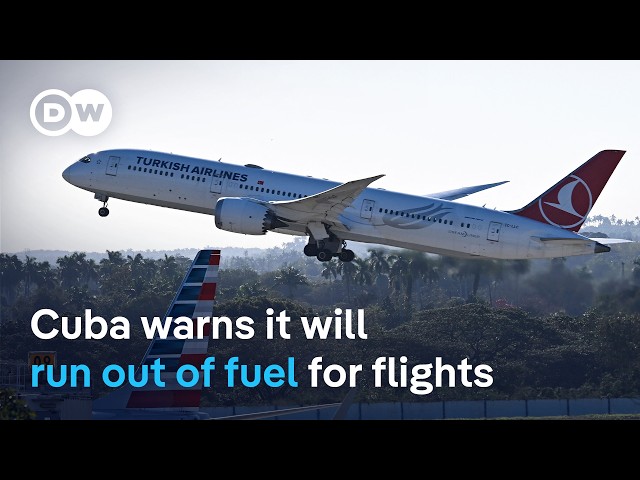
What distinguishes the current fuel crisis from previous crises in Cuba? | DW News
Feb. 10, 2026, 8:25 p.m.https://www.youtube.com/watch?v=mrbVykCgPeI
Video Transcript
Air Canada has suspended all flights to Cuba, cutting off a vital source of tourism revenue. A long-standing US embargo along with Donald Trump's recent threats to slap tariffs on any country supplying oil to the communistrun island has led to severe fuel shortages. Havana has warned that foreign airlines will no longer be able to refuel because of dwindling supplies. Cuba has run out of aviation fuel and it's already impacting tourism. With its aircraft unable to fill their tanks, Air Canada has suspended flights to the island. The airline says it will only be sending empty planes to bring stranded tourists back home. It's bad timing for the cashstrapped Caribbean island. Canada is Cuba's largest single tourism market and the suspension comes at the peak of the winter high season. Behind the travel rose is a wider regional fight. Cuba depends on fuel imports from friendly nations to keep running, but its biggest suppliers have been cut off. In early January, the US removed Venezuelan leader Nicholas Maduro from power. >> Happy new year. >> A few weeks later, Donald Trump signed an executive order threatening tariffs on any country sending oil to Cuba. That in turn led Cuba's other major supplier, Mexico, to suspend all oil shipments. Mexico's president condemned Washington's measures. >> You cannot strangle a people like this. It's very unfair. Very unfair. So, I'm calling for these sanctions to end and for support to be given to the people always. For tourists, the oil shortage could spell disruption. But for Cubans, with energy lifelines squeezed, a bad situation could soon get a lot worse. Right. I'm joined now by Ricardo Tortois Perez, an economist and research fellow at the American University Center for Latin American and Latino Studies in Washington DC. Ricardo, good to see you. For people who haven't been following uh events in Cuba closely, what does this fuel crisis uh look like on the ground? >> Great. Thanks for having me. First of all, well, it is important to say that Keans on the island have endured a difficult situation for quite some time now, years actually. So, however, this turn makes it much worse and the outlook doesn't look very bright either. People deal with long and frequent power outages, very little fuel, fewer transport, and public services. Food and basic goods are harder to find and expensive. of households spend much time uh searching and waiting. So in practice, living standards have become the main shock October in this story. So again, so it's been very very very very difficult for Cubans and continues to be so on the ground right now. After the the recent collapse of traditional oil lifelines from from Venezuela and and from Mexico, are there any any countries on the horizon who might be willing or able to step in as new energy suppliers? Or has the political cost of helping Cuba become just too high at the moment, >> right? Well, there's always room for some speculation, right? But I don't see something like that happening quickly and definitely not at the same scale. you know oil flows they require a steady supply insuran shipping financing and exactly that's what exactly the US pressure is strongest right now so Mexico has played a role recently uh but even that channel is now under strain we know you know some partners and I'm thinking about Russia specifically may help at the margin but I think that you know replacing Venezuela or Mexico for that matter in full will be hard without both money and a safer payments and shipping path. Uh Russia has the material capacity, but it has to be seen whether it has the will to uh you know face the US on on on the on Cuba. >> Ricardo, you talked about food getting more expensive. You spoke about also how it's not going to be easy to replace the traditional streams of oil. Does that add up to conditions that could trigger social unrest in any way in Cuba? >> Well, unrest is always a possibility, right? So, when no one anticipated it, so we saw what happened on July 11th, 2021. And I think the risk here that we see a combination of three things that are quite powerful. One is long blackouts. Uh there are jumps in prices and there is visible shortages right of basic things, food, fuel, medicine. And I believe that especially when people do not see near-term relief for those for that suffering, well there is a chance that they uh may take on on on the street. At the same time uh from what we saw in the past the same can respond with tighter control. So you know always uh in in cases like this outcomes are hard to to to predict. >> Talking us through the Cuban fuel crisis Ricardo Tesos Perez an economist and research fellow at the American University. We thank you so much for your time. >> Thank you.
Video Summary
Overview
The video discusses the suspension of Air Canada flights to Cuba due to a severe aviation fuel shortage on the island. This crisis, stemming from U.S. sanctions and the collapse of traditional oil suppliers Venezuela and Mexico, is crippling tourism and severely impacting daily life for Cubans, raising concerns about potential social unrest.
Key Takeaways
- Air Canada has suspended all flights to Cuba because the country has run out of aviation fuel, stranding tourists and cutting off vital tourism revenue.
- The fuel crisis is a result of U.S. pressure, including an embargo and threats of tariffs, which led to the collapse of Cuba's main oil suppliers, Venezuela and Mexico.
- On the ground, Cubans face frequent power blackouts, severe fuel shortages, reduced transport, and scarce, expensive food and basic goods.
- Replacing the lost oil supply at scale is unlikely in the near term due to financial, logistical, and political hurdles, despite potential marginal help from countries like Russia.
- The combination of blackouts, price spikes, and visible shortages creates a risk of social unrest, similar to protests seen in 2021, though the government may respond with tighter control.
Conclusion
The Cuban fuel crisis, exacerbated by international politics, has escalated from a travel disruption to a severe humanitarian and economic emergency. With no quick solution in sight, the situation threatens to further degrade living standards and potentially destabilize the country.