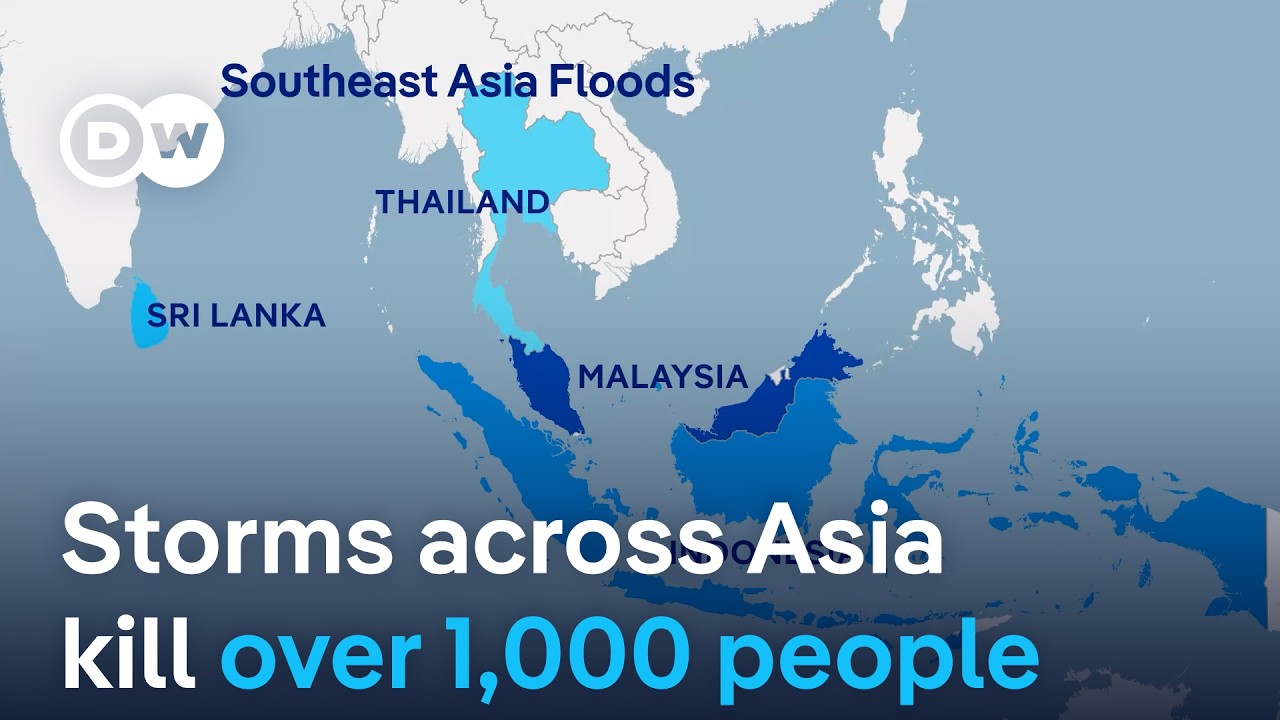
Death toll from storms across Southeast Asia rises to more than 1,000 | DW News
Dec. 1, 2025, 9:22 p.m.https://www.youtube.com/watch?v=oMg3-IhWsZg
Video Transcript
And the death toll from storms across Asia that began last week have now risen uh above 1,000. And numbers expected to grow as emergency teams scale up search and relief efforts across the region. Sri Lanka, Thailand, and Malaysia are all dealing with loss of life and widespread devastation. Indonesia has been worst hit with rescuers only now able to reach some of the affected areas. >> As rain and flood waters recede in Indonesia, the scale of devastation is becoming clear. Thick mud covers entire villages, coating homes, crops, and vehicles. There was nothing that could be saved, just my clothes. When I tried to get something, the water reached my head. I was swept away. >> While hundreds have been confirmed killed in the flooding and landslides, hundreds more remain missing. Rescue workers are racing to reach some of the hardest hit on the island of Somatra, digging into landslides as they search for anyone who may have become trapped. With roads and access cut off, thousands are still without access to critical supplies. >> I hope the government will help us more quickly in the future, especially for school children, it would be a shame if they weren't in school for too long. As for my home, it was destroyed. Indonesia was just one of several countries in the wider region to be hit by torrential rain. The annual monsoon season has coincided with tropical storms to cause some of the worst flooding in years. Several people were killed in Malaysia in addition to more than 160 people in Thailand and at least 350 in Sri Lanka. Sri Lanka's government has declared a state of emergency, describing it as the quote most challenging natural disaster in the country's history. Scientists warn climate change is turbocharging storms like those seen in recent weeks. With the warmer atmosphere holding more moisture and creating more devastating heavy rain events. Well, Amal Aaya Singa is Colombo bureau chief for the news agency AFP in Sri Lanka. He told me how bad the flooding was. >> Well, the floods seem to be receding particularly in and around the capital. But in the central part of the country with some of the roads roads being cleared the the picture that is emerging is quite bleak. We have something like 350 people confirmed killed at the moment and another 370 or so listed as missing for the last 3 or 4 days. So even today, security forces uh dug out several bodies of people who had been buried alive. So as uh access becomes easier, the the grim task of uh clearing the uh debris and pulling out bodies has begun. So it it looks like uh sadly the deck toll will climb. >> And how is that access being achieved? We're looking at at pictures of of helicopters and boats going into places. >> Yes. uh around the capital some of the low-lying areas have been flooded and the Navy has been using boats to access those people. In some cases, water has gone above the second floor of some of the buildings and singlestory houses you just can't even see them. So the the Navy is taking care of sending supplies and transporting them to uh safety, evacuating them and things like that. But the worst affected is the central uh hill country where you have lot of tea plantations. The mountains were uh became very saturated with intense rain for about four or five days and some of the mountain slopes came crashing down. So they have uh trees coming down has actually blocked access and also earth what we call landslides. So getting into those places has been very difficult. So we we really don't have a full complete picture from particularly from uh the districts which are in the center of the country and Colbo has asked for international assistance. What's needed? Well, essentially for the immediate uh uh relief operations uh they need things like uh uh some kind of expertise to go and dig in these places where people are buried because some of the houses have been buried. So it's possible that there could still be some people trapped alive. So for for that kind of recovery, Sri Lankans don't really have that kind of expertise. So already we know that the uh the Indians have sent sent some specialized teams so as Pakistan and Japan has pledged a lot of assistance especially with the medical teams. So that is what what Sri Lanka is looking for immediately. But the real big task of cleaning up and then subsequently rebuilding now that's going to be something very very challenging for the Sri Lankan government with actually coming out of a very serious economic crisis. Now >> Amal Sri Lanka does have a monsoon climate and suffers regular floods. Is is this disaster in line with previous events? Well, the monsoon is actually quite welcome in Sri Lanka because lot of hydroele electricity is generated from monsoon rains. But in this case, it is the problem is that you had such intense rain within a very short period of time. In some places there was 500 mm of rain in just a matter of 12 hours. That's roughly about a year's rain within 12 hours. So that has really caused massive flooding almost everywhere in the country. Now what is unique about this disaster is that every district in the country has been affected in some way or the other. Uh previous big drought or previous big flood we had in Sri Lanka was 16 and 2017 but they were kind of localized in a particular area. This time it's across the country. So that is why it has become quite difficult to deal with this with this disaster compared to previous ones. >> Thank you so much for talking us through that. Amal Amal J Singer from AFP news agency in Colbo. >> Thank you for having me.
Video Summary
Overview
A news report detailing severe storms and flooding across Asia, with a death toll exceeding 1,000. The report focuses on the widespread devastation in Indonesia, Sri Lanka, Thailand, and Malaysia, highlighting rescue efforts, access challenges, and the role of climate change in intensifying the disaster.
Key Takeaways
- Death toll from storms across Asia has risen above 1,000 and is expected to grow.
- Indonesia, Sri Lanka, Thailand, and Malaysia are severely affected, with Indonesia worst hit.
- Rescue teams are racing against time to reach isolated areas and find missing people.
- Sri Lanka has declared a state of emergency, calling it the country's most challenging natural disaster.
- Scientists link the extreme rainfall and devastation to climate change, which intensifies storms.
- Sri Lanka's disaster is unique due to its nationwide scale, with some areas receiving a year's rain in 12 hours.
- International assistance is being provided for specialized rescue and recovery operations.
Conclusion
The region is facing a catastrophic natural disaster exacerbated by climate change, with immediate focus on search, rescue, and relief. The long-term challenge will be rebuilding, particularly for countries like Sri Lanka already grappling with economic crisis.